

- 2LP (Pre-Order)
Éliane Radigue
Occam XIII, Occam River XI, Occam V
Blank Forms Editions
- Cat No: BF076
- updated:2026-09-24
Track List
-
1. Occam XIII for bassoon
-
2. Occam River XI for bassoon and cello (17' 12
-
3. Occam V for cello
-
4. Occam River XI for bassoon and cello (17' 16
Occam Ocean is a series of acoustic compositions made for and with individual instrumentalists by the late French composer Éliane Radigue. Extending the interactive process pioneered in Naldjorlak (2005–2009), Occam Ocean employs a scoreless method of composing in dialogue with each performer. Dating back to 2011, the series has proliferated almost organically, growing out of a musical and social dynamic of combinatoriality and multiplication to a catalog of more than eighty discrete compositions. This body of work stands as one of the most extraordinary late-career outpourings in recent music history.
The Occam series was catalyzed in part by a visit to the Natural History Museum in Los Angeles, where Radigue encountered a depiction of the electromagnetic spectrum—from radio signals to gamma rays—which impressed upon her the minuscule range of human hearing relative to the seemingly unlimited compass of universal wavelength and frequency. The Occam compositions seem to address this vertiginous confrontation with the infinite; each individual composition elaborates a radically reduced technique or sound process, frequently working outward from only a handful of fundamental tones, to expose the flickering, idiosyncratic spectral behavior of the instrument. The reference to William of Ockham indicates a principled commitment to parsimony; paradoxically, the reduction in material content makes possible an incommensurate richness in perceived acoustical detail.
Notable in the Occam series is the inextricable identification of the composition with the performer for whom, and with whom, it was made. The particular sounds and techniques of each individual performer are thus indelibly stamped in the composition; the piece composes the playing of that musician, as much as the musician plays the composition. The time-honored division of labor between performer and composer is thus suspended and reconfigured, proposing a model for new music composition that has not yet been fully theorized or understood.
Occam XIII, Occam River XI (presented here in two distinct readings, which reveal subtle variations in instrumental response), and Occam V feature two longtime collaborators of Radigue in solo and duo formations. Charles Curtis, the first instrumentalist for whom Radigue wrote an acoustic composition (Naldjorlak), performs on cello, while Dafne Vicente-Sandoval—whose parallel investigations into her instrument’s complex sounding properties led her to collaborate with Radigue—performs on bassoon. The works were recorded at Temple Saint-Théodule, La Tour-de-Peilz, Switzerland, during a 2024 residency at La Becque, a setting previously explored by the musicians for its distinctive acoustic properties.
Éliane Radigue
Dafne Vicente-Sandoval—bassoon
Charles Curtis—cello
Blank Forms Editions BF-076
La Becque Editions LB-015
©2026
Blank Forms, New York
La Becque | Résidence d’artistes, La Tour-de-Peilz, Switzerland
Recorded by Blaise Favre at Temple Saint-Théodule, La Tour-de-Peilz,
on April 11 and 12, 2024
Occam XIII mixed by Paul Alkhallaf
Occam V, Occam River XI (17:12), and Occam River XI (17:16) mixed by Sam Dunscombe
Post-production by Robbie Lee
Design by Alec Mapes-Frances
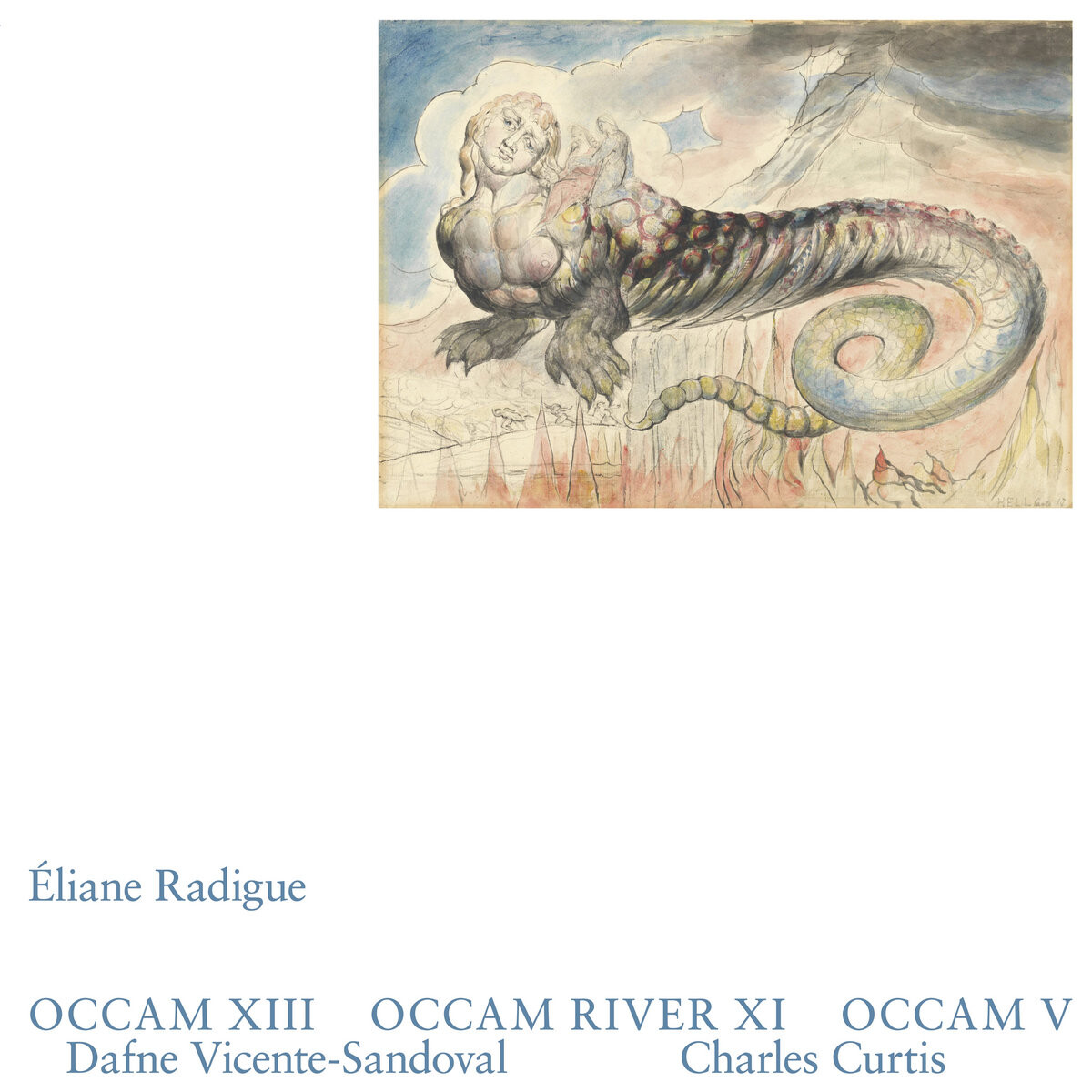
Cover image William Blake, Geryon conveying Dante and Virgil down towards Malebolge (1824–1827), illustration for The Divine Comedy by Dante Alighieri (Inferno XVII).
The Occam series was catalyzed in part by a visit to the Natural History Museum in Los Angeles, where Radigue encountered a depiction of the electromagnetic spectrum—from radio signals to gamma rays—which impressed upon her the minuscule range of human hearing relative to the seemingly unlimited compass of universal wavelength and frequency. The Occam compositions seem to address this vertiginous confrontation with the infinite; each individual composition elaborates a radically reduced technique or sound process, frequently working outward from only a handful of fundamental tones, to expose the flickering, idiosyncratic spectral behavior of the instrument. The reference to William of Ockham indicates a principled commitment to parsimony; paradoxically, the reduction in material content makes possible an incommensurate richness in perceived acoustical detail.
Notable in the Occam series is the inextricable identification of the composition with the performer for whom, and with whom, it was made. The particular sounds and techniques of each individual performer are thus indelibly stamped in the composition; the piece composes the playing of that musician, as much as the musician plays the composition. The time-honored division of labor between performer and composer is thus suspended and reconfigured, proposing a model for new music composition that has not yet been fully theorized or understood.
Occam XIII, Occam River XI (presented here in two distinct readings, which reveal subtle variations in instrumental response), and Occam V feature two longtime collaborators of Radigue in solo and duo formations. Charles Curtis, the first instrumentalist for whom Radigue wrote an acoustic composition (Naldjorlak), performs on cello, while Dafne Vicente-Sandoval—whose parallel investigations into her instrument’s complex sounding properties led her to collaborate with Radigue—performs on bassoon. The works were recorded at Temple Saint-Théodule, La Tour-de-Peilz, Switzerland, during a 2024 residency at La Becque, a setting previously explored by the musicians for its distinctive acoustic properties.
Éliane Radigue
Dafne Vicente-Sandoval—bassoon
Charles Curtis—cello
Blank Forms Editions BF-076
La Becque Editions LB-015
©2026
Blank Forms, New York
La Becque | Résidence d’artistes, La Tour-de-Peilz, Switzerland
Recorded by Blaise Favre at Temple Saint-Théodule, La Tour-de-Peilz,
on April 11 and 12, 2024
Occam XIII mixed by Paul Alkhallaf
Occam V, Occam River XI (17:12), and Occam River XI (17:16) mixed by Sam Dunscombe
Post-production by Robbie Lee
Design by Alec Mapes-Frances
Cover image William Blake, Geryon conveying Dante and Virgil down towards Malebolge (1824–1827), illustration for The Divine Comedy by Dante Alighieri (Inferno XVII).
▫️information▫️
『Occam Ocean is a series of acoustic compositions made for and with individual instrumentalists by the late French composer Éliane Radigue. Extending the interactive process pioneered in Naldjorlak (2005–2009), Occam Ocean employs a scoreless method of composing in dialogue with each performer. Dating back to 2011, the series has proliferated almost organically, growing out of a musical and social dynamic of combinatoriality and multiplication to a catalog of more than eighty discrete compositions. This body of work stands as one of the most extraordinary late-career outpourings in recent music history.
The Occam series was catalyzed in part by a visit to the Natural History Museum in Los Angeles, where Radigue encountered a depiction of the electromagnetic spectrum—from radio signals to gamma rays—which impressed upon her the minuscule range of human hearing relative to the seemingly unlimited compass of universal wavelength and frequency. The Occam compositions seem to address this vertiginous confrontation with the infinite; each individual composition elaborates a radically reduced technique or sound process, frequently working outward from only a handful of fundamental tones, to expose the flickering, idiosyncratic spectral behavior of the instrument. The reference to William of Ockham indicates a principled commitment to parsimony; paradoxically, the reduction in material content makes possible an incommensurate richness in perceived acoustical detail.
Notable in the Occam series is the inextricable identification of the composition with the performer for whom, and with whom, it was made. The particular sounds and techniques of each individual performer are thus indelibly stamped in the composition; the piece composes the playing of that musician, as much as the musician plays the composition. The time-honored division of labor between performer and composer is thus suspended and reconfigured, proposing a model for new music composition that has not yet been fully theorized or understood.
Occam XIII, Occam River XI (presented here in two distinct readings, which reveal subtle variations in instrumental response), and Occam V feature two longtime collaborators of Radigue in solo and duo formations. Charles Curtis, the first instrumentalist for whom Radigue wrote an acoustic composition (Naldjorlak), performs on cello, while Dafne Vicente-Sandoval—whose parallel investigations into her instrument’s complex sounding properties led her to collaborate with Radigue—performs on bassoon. The works were recorded at Temple Saint-Théodule, La Tour-de-Peilz, Switzerland, during a 2024 residency at La Becque, a setting previously explored by the musicians for its distinctive acoustic properties.
Éliane Radigue
Dafne Vicente-Sandoval—bassoon
Charles Curtis—cello
Blank Forms Editions BF-076
La Becque Editions LB-015
©2026
Blank Forms, New York
La Becque | Résidence d’artistes, La Tour-de-Peilz, Switzerland
Recorded by Blaise Favre at Temple Saint-Théodule, La Tour-de-Peilz,
on April 11 and 12, 2024
Occam XIII mixed by Paul Alkhallaf
Occam V, Occam River XI (17:12), and Occam River XI (17:16) mixed by Sam Dunscombe
Post-production by Robbie Lee
Design by Alec Mapes-Frances
Cover image William Blake, Geryon conveying Dante and Virgil down towards Malebolge (1824–1827), illustration for The Divine Comedy by Dante Alighieri (Inferno XVII).
』