

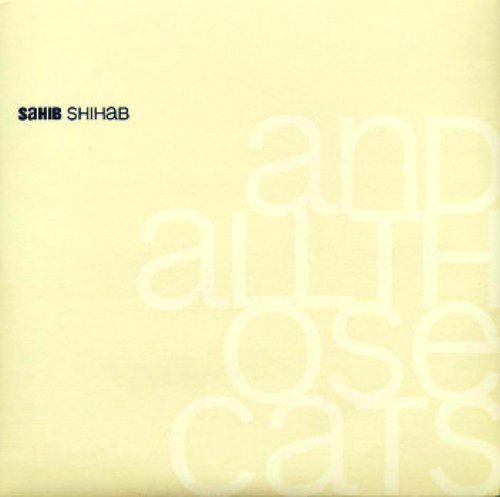
- 2LP
- Recommended
- Back In
Sahib Shihab
And All Those Cats
Rearward - Cat No: RW102LP
- updated:2025-06-01
"In many ways, Sahib Shihab was the Thelonious Monk of the baritone sax." A classic 2LP from Rearward compiling recordings made between 1964 and 1970 by Sahib Shihab after he relocated to Europe, cut with fellow American expatriate in Paris — the powerhouse drummer Kenny Clarke — along with bassist Jimmy Woode, Belgium's Francy Boland, and Fats Sadi. In stock.
Track List
-
A1. Set Up
2:57 -
A2. Peter's Waltz
4:52 -
A3. Yah, Yah Blues
3:59 -
A4. End Of A Love Affair
3:58 -
B1. Om Mani Padme Hum
5:42 -
B2. Bohemia After Dark
3:38 -
B3. Campi's Idea
8:25 -
C1. Jay-Jay
2:52 -
C2. Waltz For Seth
6:17 -
C3. Herr Fixit
5:29 -
C4. Stoned Ghosts
5:00 -
D1. Companionship (I+II)
4:13 -
D2. CT+CB
5:20 -
D3. Djdar, Djar
4:20 -
D4. Talk Some Yak-Ee-Dak
3:48
Sahib Shihab was, in many ways, the Thelonious Monk of the baritone saxophone. Like Monk, he was an uncompromising individualist with an idiosyncratic, often quirky, approach to improvisation. And, in fact, Shihab and Monk had a strong mutual affinity. They worked together in the late forties and early fifties and became good friends. Shihab admired Monk for his oblique approach to jazz and his resolute non-con- formity and he shared much of Monk's musical philosphy.
He joined Luther Henderson's band before he was 16 but left soon afterwards to enrol for a year at Boston Conservatory. He then had a two year spell with Fletcher Henderson and later worked with Roy Eldridge. It was after he heard Charlie Parker that Shihab's music became strongly bop orientated.
He did his first record date with Thelonious Monk in November 1947 and later he worked with Art Blakey, Tadd Dameron, Dizzy Gillespie, Oscar Pettiford, John Coltrane and Illinois Jacquet. It was in 1951 that he added baritone saxophone to his range of instruments.
When the opportunity came, in 1959, to join the band of Quincy Jones for a tour of Europe with the musical Free And Easy, Shihab accepted it with alacrity because he had become disullusioned with the politics and racism of the United States. And when the tour ended, Shihab decided to remain in Europe, settling in Copenhagen, where he taught at the Polytechnic High School and also composed music for the cinema, television and the theatre.
Shihab joined the Clarke-Boland Big Band in 1961 and remained a regular member of the ensemble untii it broke up in April 1972. He returned to the United States for a three-year spell in 1973, basing himself in Los Angeles, then moved back to Europe for a further period. In 1986 he went back once ag ain to America. He died in Tennessee on October 24, 1989.
The small group dates here were recorded between 1964 and 1970 and showcase the delighyfully eccentric, unorthodox improvisational style of Shihab on baritone saxophone and flute.
He joined Luther Henderson's band before he was 16 but left soon afterwards to enrol for a year at Boston Conservatory. He then had a two year spell with Fletcher Henderson and later worked with Roy Eldridge. It was after he heard Charlie Parker that Shihab's music became strongly bop orientated.
He did his first record date with Thelonious Monk in November 1947 and later he worked with Art Blakey, Tadd Dameron, Dizzy Gillespie, Oscar Pettiford, John Coltrane and Illinois Jacquet. It was in 1951 that he added baritone saxophone to his range of instruments.
When the opportunity came, in 1959, to join the band of Quincy Jones for a tour of Europe with the musical Free And Easy, Shihab accepted it with alacrity because he had become disullusioned with the politics and racism of the United States. And when the tour ended, Shihab decided to remain in Europe, settling in Copenhagen, where he taught at the Polytechnic High School and also composed music for the cinema, television and the theatre.
Shihab joined the Clarke-Boland Big Band in 1961 and remained a regular member of the ensemble untii it broke up in April 1972. He returned to the United States for a three-year spell in 1973, basing himself in Los Angeles, then moved back to Europe for a further period. In 1986 he went back once ag ain to America. He died in Tennessee on October 24, 1989.
The small group dates here were recorded between 1964 and 1970 and showcase the delighyfully eccentric, unorthodox improvisational style of Shihab on baritone saxophone and flute.
Kenny Clarke was the revolutionary genius of bebop drumming, and after moving to Paris he also served as a bridge between European and American jazz musicians. Among the body of recordings tied to the Clarke-Boland Big Band — often called the pinnacle of European jazz — this is one of the highlights, capturing sessions of an almost miraculous caliber. These are the many recordings with saxophonist and flutist Sahib Shihab, who came to Europe on a Quincy Jones tour and, like Kenny Clarke, stayed on, settling in Copenhagen. A double-LP compilation released in 1997 on Rearward, the reissue arm of Italy's Schema, supervised by Gigi Campi himself, the man who brought the group together and supported it. Don't miss the overwhelming swing of these giants. (Original Japanese text by Saito)