

- 2LP (予約)
Éliane Radigue
Occam XIII, Occam River XI, Occam V
Blank Forms Editions
- Cat No: BF076
- updated:2026-09-24
Track List
-
1. Occam XIII for bassoon
-
2. Occam River XI for bassoon and cello (17' 12
-
3. Occam V for cello
-
4. Occam River XI for bassoon and cello (17' 16
Occam Ocean is a series of acoustic compositions made for and with individual instrumentalists by the late French composer Éliane Radigue. Extending the interactive process pioneered in Naldjorlak (2005–2009), Occam Ocean employs a scoreless method of composing in dialogue with each performer. Dating back to 2011, the series has proliferated almost organically, growing out of a musical and social dynamic of combinatoriality and multiplication to a catalog of more than eighty discrete compositions. This body of work stands as one of the most extraordinary late-career outpourings in recent music history.
The Occam series was catalyzed in part by a visit to the Natural History Museum in Los Angeles, where Radigue encountered a depiction of the electromagnetic spectrum—from radio signals to gamma rays—which impressed upon her the minuscule range of human hearing relative to the seemingly unlimited compass of universal wavelength and frequency. The Occam compositions seem to address this vertiginous confrontation with the infinite; each individual composition elaborates a radically reduced technique or sound process, frequently working outward from only a handful of fundamental tones, to expose the flickering, idiosyncratic spectral behavior of the instrument. The reference to William of Ockham indicates a principled commitment to parsimony; paradoxically, the reduction in material content makes possible an incommensurate richness in perceived acoustical detail.
Notable in the Occam series is the inextricable identification of the composition with the performer for whom, and with whom, it was made. The particular sounds and techniques of each individual performer are thus indelibly stamped in the composition; the piece composes the playing of that musician, as much as the musician plays the composition. The time-honored division of labor between performer and composer is thus suspended and reconfigured, proposing a model for new music composition that has not yet been fully theorized or understood.
Occam XIII, Occam River XI (presented here in two distinct readings, which reveal subtle variations in instrumental response), and Occam V feature two longtime collaborators of Radigue in solo and duo formations. Charles Curtis, the first instrumentalist for whom Radigue wrote an acoustic composition (Naldjorlak), performs on cello, while Dafne Vicente-Sandoval—whose parallel investigations into her instrument’s complex sounding properties led her to collaborate with Radigue—performs on bassoon. The works were recorded at Temple Saint-Théodule, La Tour-de-Peilz, Switzerland, during a 2024 residency at La Becque, a setting previously explored by the musicians for its distinctive acoustic properties.
Éliane Radigue
Dafne Vicente-Sandoval—bassoon
Charles Curtis—cello
Blank Forms Editions BF-076
La Becque Editions LB-015
©2026
Blank Forms, New York
La Becque | Résidence d’artistes, La Tour-de-Peilz, Switzerland
Recorded by Blaise Favre at Temple Saint-Théodule, La Tour-de-Peilz,
on April 11 and 12, 2024
Occam XIII mixed by Paul Alkhallaf
Occam V, Occam River XI (17:12), and Occam River XI (17:16) mixed by Sam Dunscombe
Post-production by Robbie Lee
Design by Alec Mapes-Frances
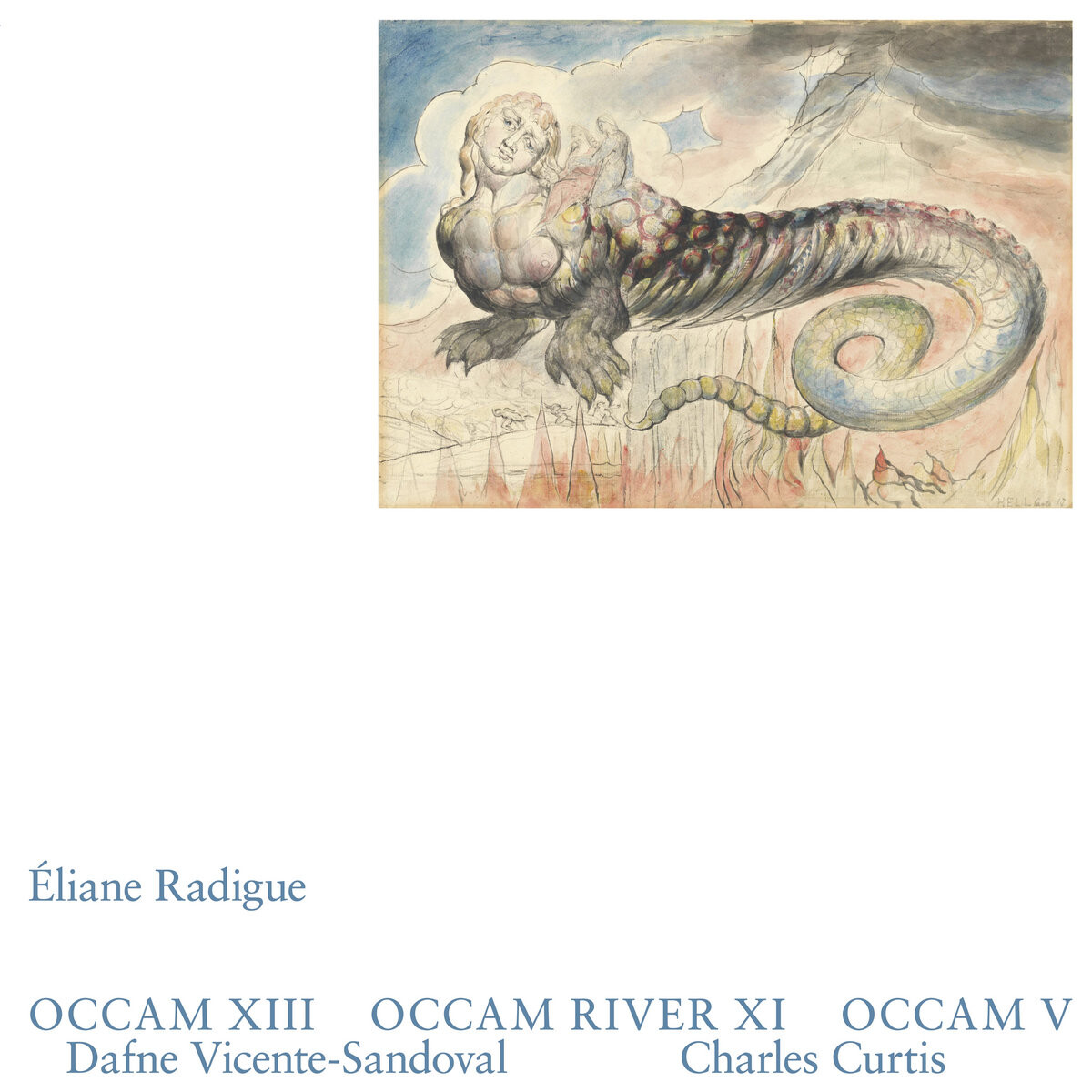
Cover image William Blake, Geryon conveying Dante and Virgil down towards Malebolge (1824–1827), illustration for The Divine Comedy by Dante Alighieri (Inferno XVII).
The Occam series was catalyzed in part by a visit to the Natural History Museum in Los Angeles, where Radigue encountered a depiction of the electromagnetic spectrum—from radio signals to gamma rays—which impressed upon her the minuscule range of human hearing relative to the seemingly unlimited compass of universal wavelength and frequency. The Occam compositions seem to address this vertiginous confrontation with the infinite; each individual composition elaborates a radically reduced technique or sound process, frequently working outward from only a handful of fundamental tones, to expose the flickering, idiosyncratic spectral behavior of the instrument. The reference to William of Ockham indicates a principled commitment to parsimony; paradoxically, the reduction in material content makes possible an incommensurate richness in perceived acoustical detail.
Notable in the Occam series is the inextricable identification of the composition with the performer for whom, and with whom, it was made. The particular sounds and techniques of each individual performer are thus indelibly stamped in the composition; the piece composes the playing of that musician, as much as the musician plays the composition. The time-honored division of labor between performer and composer is thus suspended and reconfigured, proposing a model for new music composition that has not yet been fully theorized or understood.
Occam XIII, Occam River XI (presented here in two distinct readings, which reveal subtle variations in instrumental response), and Occam V feature two longtime collaborators of Radigue in solo and duo formations. Charles Curtis, the first instrumentalist for whom Radigue wrote an acoustic composition (Naldjorlak), performs on cello, while Dafne Vicente-Sandoval—whose parallel investigations into her instrument’s complex sounding properties led her to collaborate with Radigue—performs on bassoon. The works were recorded at Temple Saint-Théodule, La Tour-de-Peilz, Switzerland, during a 2024 residency at La Becque, a setting previously explored by the musicians for its distinctive acoustic properties.
Éliane Radigue
Dafne Vicente-Sandoval—bassoon
Charles Curtis—cello
Blank Forms Editions BF-076
La Becque Editions LB-015
©2026
Blank Forms, New York
La Becque | Résidence d’artistes, La Tour-de-Peilz, Switzerland
Recorded by Blaise Favre at Temple Saint-Théodule, La Tour-de-Peilz,
on April 11 and 12, 2024
Occam XIII mixed by Paul Alkhallaf
Occam V, Occam River XI (17:12), and Occam River XI (17:16) mixed by Sam Dunscombe
Post-production by Robbie Lee
Design by Alec Mapes-Frances
Cover image William Blake, Geryon conveying Dante and Virgil down towards Malebolge (1824–1827), illustration for The Divine Comedy by Dante Alighieri (Inferno XVII).
『『オカム・オーシャン』は、故フランス人作曲家エリアーヌ・ラディグが、個々の演奏家のために、そして彼らと共同で制作したアコースティック作品シリーズである。『ナルジョラク』(2005年〜2009年)で先駆的に取り入れられた対話的な制作プロセスをさらに発展させた『オカム・オーシャン』は、各演奏者との対話を通じて、楽譜を用いない作曲手法を採用している。 2011年にさかのぼるこのシリーズは、組み合わせと増殖という音楽的・社会的なダイナミクスから生まれ、ほぼ有機的に広がりを見せ、80曲以上の独立した作品群へと発展した。この一連の作品は、近年の音楽史において、最も非凡な晩年の創作活動の一つとして位置づけられている。 『オッカム』シリーズは、ロサンゼルス自然史博物館への訪問がきっかけの一つとなった。そこでラディグは、電波からガンマ線に至る電磁スペクトルの図解を目にし、宇宙の波長と周波数の限りなく広大な範囲に比べ、人間の聴覚の範囲がいかに微々たるものであるかを痛感した。 『オカム』シリーズの作品は、この無限との目眩がするような対峙に言及しているように見える。個々の作品は、徹底的に簡素化された技法や音響プロセスを展開し、多くの場合、ごく少数の基音から外側へと展開していくことで、楽器の揺らめくような、独特なスペクトル的挙動を浮き彫りにしている。 ウィリアム・オブ・オッカムへの言及は、簡潔さへの原則的なこだわりを示唆している。逆説的ではあるが、素材の内容を削減することで、知覚される音響的細部において計り知れない豊かさが可能となるのである。 オッカム・シリーズで特筆すべきは、その作曲が、そのために、そしてその演奏者と共に作られたものであるという点で、作曲と演奏者が不可分に同一視されていることだ。こうして、個々の演奏者固有の音や技法が、その楽曲に消すことのできない刻印として刻み込まれる。つまり、その音楽家が楽曲を演奏するのと同様に、楽曲そのものがその音楽家の演奏を構成しているのだ。 こうして、演奏者と作曲家の間にある伝統的な役割分担は一旦停止され、再構成されることで、まだ十分に理論化も理解もされていない新しい音楽作曲のモデルが提示されている。 『オカム XIII』、『オカム・リバー XI』(ここでは、楽器の響きの微妙な違いが浮かび上がる2つの異なる演奏が提示されている)、そして『オカム V』では、ラディグの長年の共同制作者2人が、ソロおよびデュオの編成で演奏を披露している。 ラディグが初めてアコースティック作品(『ナルジョラク』)を書き下ろした奏者であるチャールズ・カーティスがチェロを、自身の楽器の複雑な響きの特性を並行して探究していたことがきっかけでラディグとのコラボレーションに至ったダフネ・ビセンテ=サンドバルがファゴットを担当している。 これらの作品は、2024年にスイス・ラ・トゥール=ド=ペイルズのテンプル・サン=テオドゥールで、ラ・ベックでのレジデンシー期間中に録音された。この場所は、その独特な音響特性から、以前にも演奏家たちによって探求された場所である。 エリアン・ラディグ ダフネ・ビセンテ=サンドバル — ファゴット チャールズ・カーティス — チェロ Blank Forms Editions BF-076 La Becque Editions LB-015 ©2026 ブランク・フォームズ、ニューヨーク ラ・ベック | アーティスト・レジデンス、ラ・トゥール・ド・ペイル、スイス 2024年4月11日および12日、ラ・トゥール・ド・ペイルのテンプル・サン・テオドゥールにて、 ブレイズ・ファヴルによる録音 『Occam XIII』のミキシング:ポール・アルハラフ 『Occam V』、『Occam River XI (17:12)』、および『Occam River XI (17:16)』のミキシング:サム・ダンズコム ポストプロダクション:ロビー・リー デザイン:アレック・メイプス=フランシス 表紙画像:ウィリアム・ブレイク『ゲリュオンがダンテとウェルギリウスをマレボルゲへと運ぶ』(1824–1827年)、ダンテ・アリギエーリ著『神曲』(『地獄篇』第17歌)の挿絵。 (インフォメーションより)』